September 9, 2026 Breakfast Meeting Notes
Ken E led the meeting in Ben’s absence.
Russ won the 50/50 and it donated to the club.
Steve drew the 7 of diamonds win the card game.
Phil has a possible speaker, Karen Liot Hill. Please let him know if you have an open day for a speaker before the election.
Lora gave an update on the sign at the amphitheater. The Parks department has the pole and will be putting it up in concrete this week. Once that’s done, we can decide when we want to actually install the sign.
Ken W advised us that Rob Cormey at the Parks department suggested a possible project. They are hoping to put up brick pads on both sides of the pergola and put picnic tables on top of them. This will help eliminate the need for mowing that area and the tables could also be a nice place for people who buy food in town to sit and eat lunch. Rob also suggested putting in 4 bricked areas on the common for picnic tables, as people trample the grass under and around the tables and they have to keep moving then. Mike C added that the Bristol club has installed brick pads for picnic tables and they work with a vendor who puts the Rotary logo on the bricks. Mike B also suggested that we could sell bricks to help raise money for the project.
Deb noted that this Saturday is the town wide yard sale. The church has a lot of stuff to get rid of, including bulletin boards and tables.
Juanita Forbes, a former member and club president, died in August. Her celebration of life will be held here at the Common Man Inn this Saturday from 11-3.
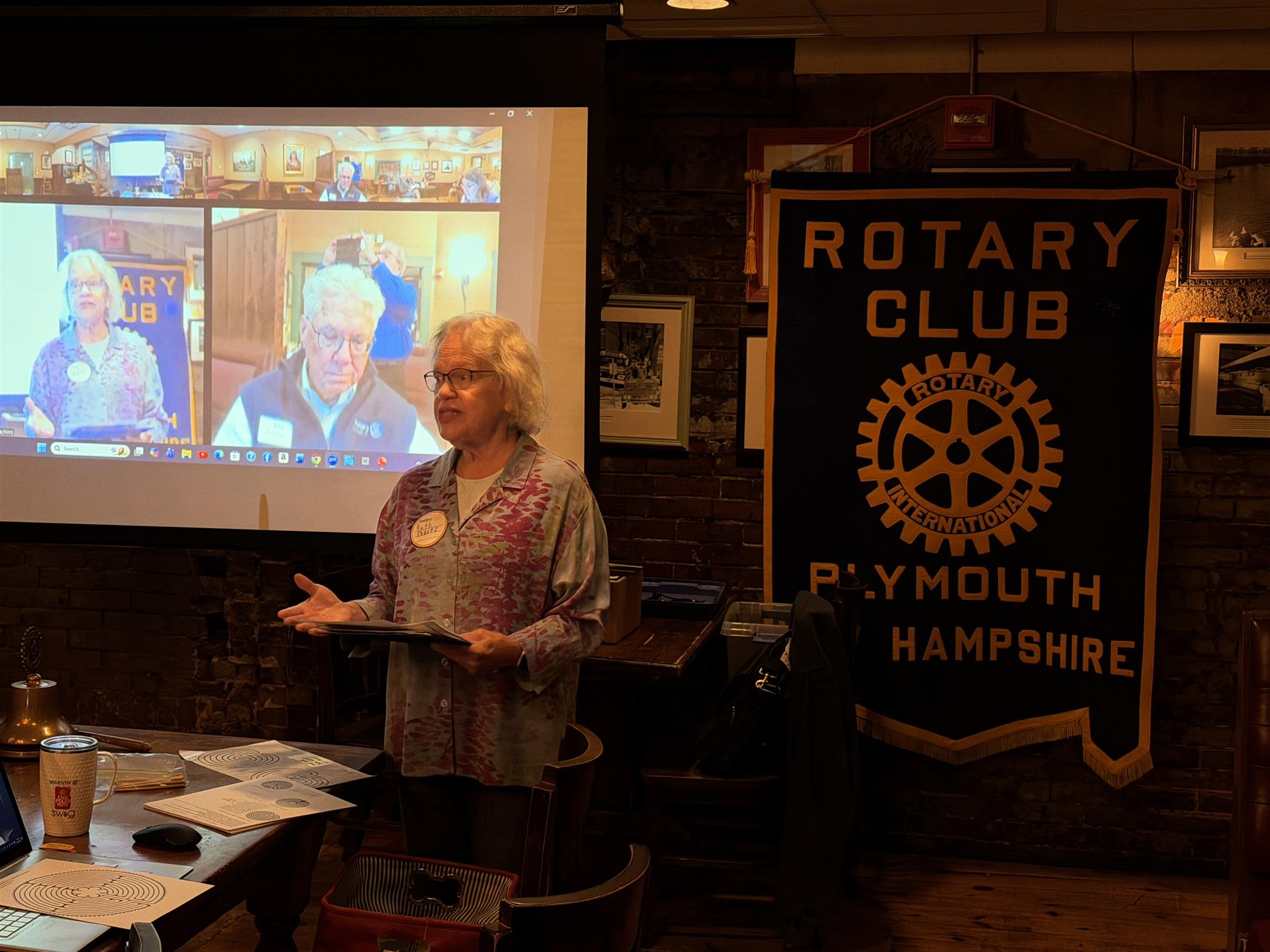
Ruth tells us all about labyrinths!
Deb introduced our speaker, Ruth from the church. Ruth spoke to us about labyrinths. She lives in Sanbornton and would be happy to have visitors to see the one that she has constructed in her yard.
Ruth’s interest in labyrinths was sparked by a retreat to the church at Chartres, France, where they have a famous 32 foot labyrinth. Labyrinths are pathways, with a single path to the center and the same path back again. This is in contrast to a maze, which has dead ends and requires one to figure out how to get to the center.
Labyrinths have been constructed by many cultures throughout history, as tools of reflection and meditation. The classic 7 circuit lab used to be called a Cretan labyrinth after the mythical labyrinth there. However. 2000 year old petroglyphs showing a labyrinth have been discovered in Spain. There is also a Baltic type of labyrinth, found in Scandinavia and northern Germany. The first Christian one was in Algiers in 325 AD. The turns and twists lead us into the center and then back out into the world. These are used for walking meditations, as a spiritual guide.
Lunations are the small lines at the edge of the labyrinth and they represent the phases of the moon. Walking the lunation is how you “open” the labyrinth. There are 3 parts to the walk: going in is regarded as “release”, during which you let go and clear your mind. At the center you “receive”, pausing as long as you want, and receive whatever comes in. Finally, you walk out and you “return” to the world with whatever you feel you’ve gained.
The labyrinth helps us quiet our minds and relax our spirits. They are used a lot for relief from grieving. There are labyrinths at churches, in prisons, at schools, and other public areas all over the world. There is a mini labyrinth at PSU. You can log in to labyrinthsociety.org for a worldwide listing of labyrinths.
Labyrinths can be made of all sorts of materials. Petals in the Pine in Canterbury has one in the trees, but many public ones are made of concrete, with lines to show the border. The Church in the Woods has one too.
Labyrinths can also be small, so-called “finger labyrinths.” These let us quiet our minds before we go to bed. You can get these made out of wood, pewter, and other materials. The first Saturday in May is International Labyrinth Day and Ruth would like to set one up on the common then. She is also hoping that she could get interested people to build one a more permanent one in Plymouth.
Steve informed us that the only national park in New Hampshire is in Cornish, home to the St. Gaudens National Park. There are topiaries and sculptures there, as well as a labyrinth. It is a fascinating place to visit.
Mike C said that his son and family will be visiting here in about a month (October 7). If you would be able to run the Owl in his absence, let him know.
On October 9 at Dartmouth, the Common Man for Ukraine will be holding a klezmer concert at the student center. The Hanover Rotary club is the main sponsor of this event. There will also be concerts in Philadelphia and NYC. All are invited.
Happy dollars were shared by Mike, Ken W, Mike W, Phil, and Deb.
Phil announced that on Sept 18-20 there will be a curling tournament at the PSU rink. See him for more information.
Respectfully submitted,
Lora Miller, secretary